
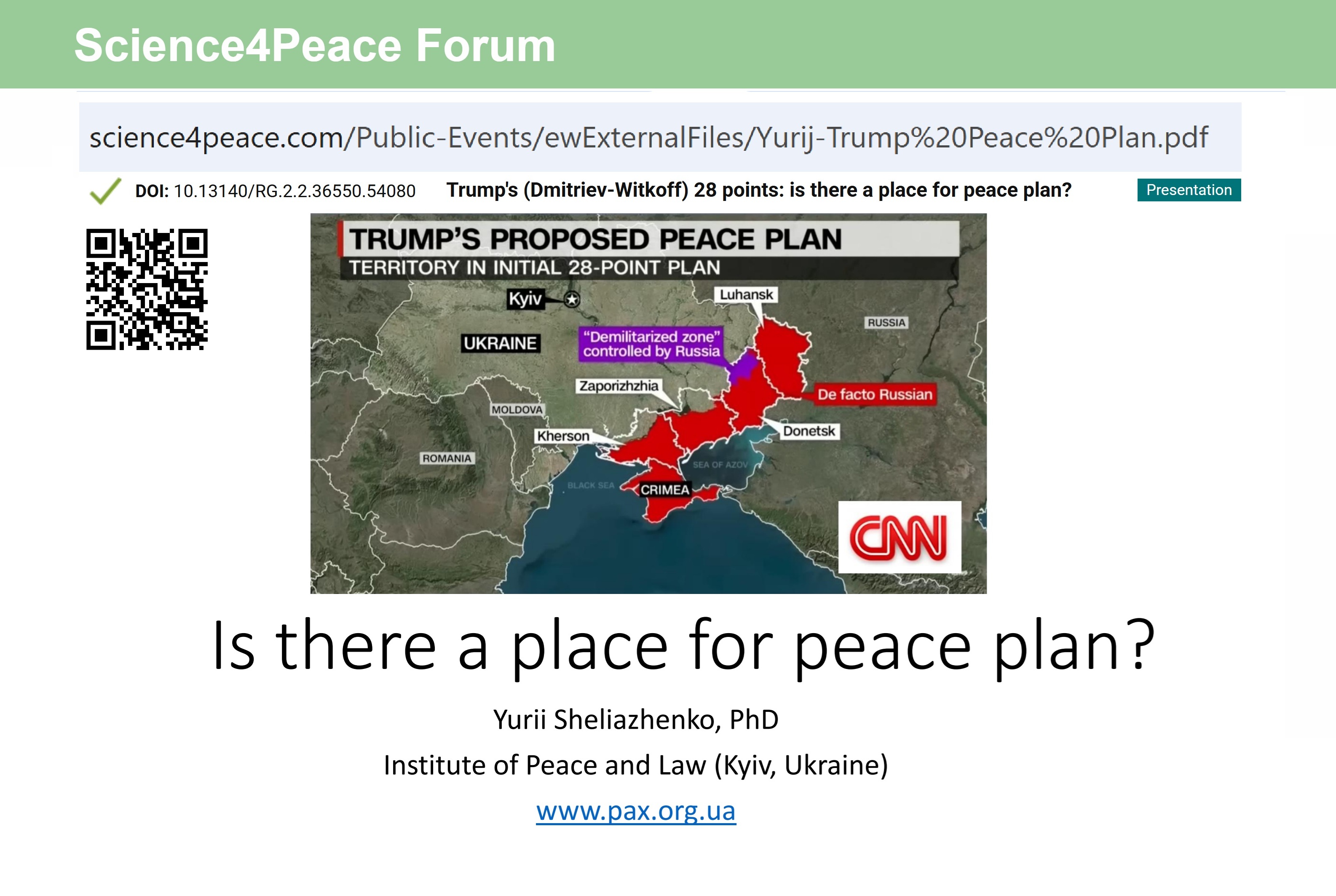
In presentation delivered at the webinar “The Trump Peace Plan” organized by the Science4Peace Forum, I argued that peace deal or even fragile ceasefire on terms proposed in the 28 points is not likely to happen, because Ukrainian government is not going to give up lands, aspirations of Euro-Atlantic integration, sovereignty, and Russian government is not going to give up claims related to temporarily occupied territories of Ukraine and great-power sphere of influence.
There are signs that Trump’s plan is mainly aimed at asserting U.S. global leadership and economic interests, as well as Trump’s personal interests, including power grab, market speculations and curbing domestic unrest. U.S.-Russia secret talks, manipulative and hardly in good faith on both sides (e.g. promising peace to people while investing into endless war at the same time, with insider trading of war industry stocks), and attempts to establish a great power dominance are part of problem of a corrupted militarist quest for absolute power that causes escalation of tensions globally.
It further argued from a pacifist point of view that we need agreement between peoples rather than militarized governments on how to nonviolently resist all wars and militarism.
Only institutionalization and knowledge-based development of nonviolent power of the people to stop and to prevent wars by civil disobedience, starting from refusal to kill, could end current widespread preparations for and investments of the public funds into large-scale war in Europe, that might cause a catastrophe such as the new Thirty Years’ War that might be ended only with a new peace treaty among peoples self-organized on the basis of antimilitarism, reasserting Westphalian commitments of 17th century to freedom of conscience and dissolution of armies on the basis of the new social contract on democratic peace and abolition of war and removal of all causes of wars, preventing any attempts to enact public policies based on greed for absolute power and harmful enrichment, curbing destructive great-power, national or corporate egoism, with a rigorous system of the monitoring, early risk prevention and effective peaceful action by civil societies.
Yurii Sheliazhenko, director of the Institute of Peace and Law